


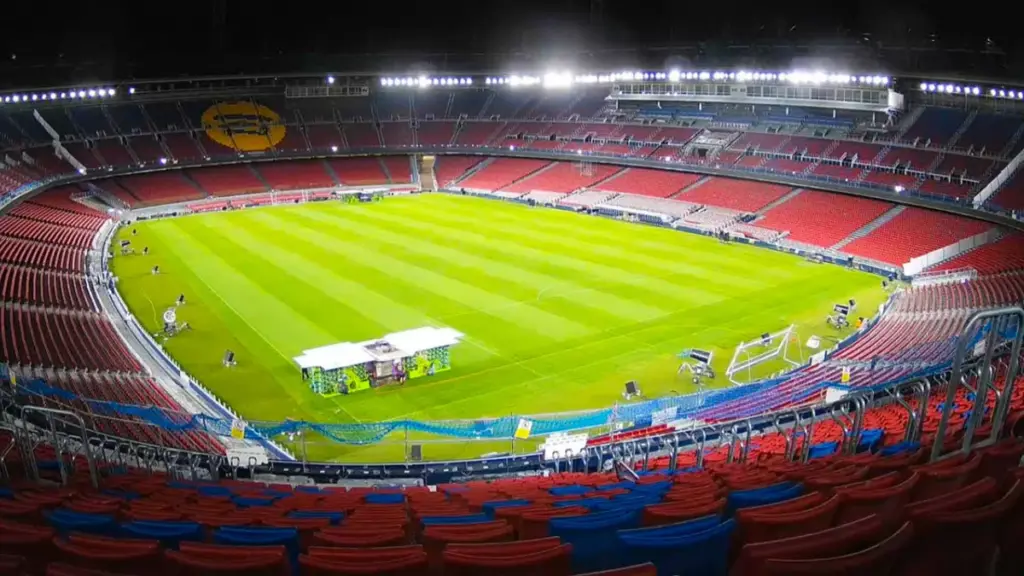
The losses Barça will suffer if they don’t return to Spotify Camp Nou
- Noticia publicada: 10/09/2025 - 18:19H
- Última actualización: 27/03/2026 - 11:30H
Barça must return to the Spotify Camp Nou as soon as possible, not only because of what the stadium represents on a sporting level, but also because of the financial commitments made by the board
The board of FC Barcelona is in a great hurry to finally resolve the return of the first men’s team to the Spotify Camp Nou. Delays in the Espai Barça project may cause million-dollar losses in the 2025/26 financial year due to sponsorship and financing commitments previously acquired by the club.
In this regard, journalists Sique Rodríguez and Adrià Soldevila, on the program ‘Què t’hi jugues’ of the ‘SER’ network, recall that the club must begin to pay the interest on the work (its cost is around €1,500 million) in December of this year, with the first payment being 44 million euros. This amount will be more than double in December 2026, reaching 94 ‘kilos’.
The project’s investors are confident of recovering their investment once the Estadi is fully operational, but this will hopefully happen at the end of 2026 or the beginning of 2027, with the installation of the roof. In the meantime, Barça must meet its obligations with the agreed interest rates (the average is around 5.5%).
The VIP boxes, another urgency of the new Spotify Camp Nou
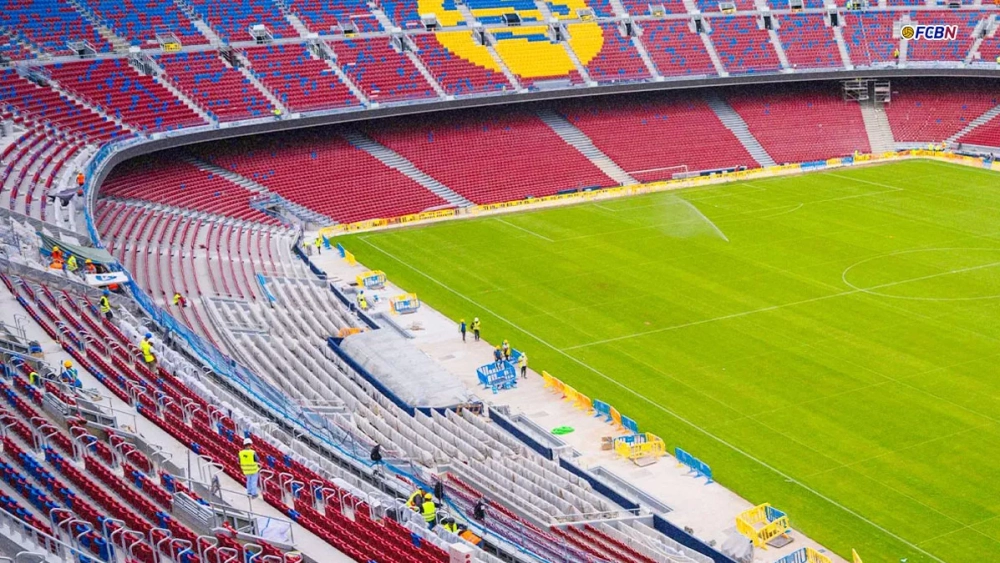
Clearly, the club needs to generate as much revenue as possible from ticket sales in 25/26. Upon completion of phase 1C, the capacity of the Spotify Camp Nou will be 60,000 spectators, 10,000 more than the limit enabled in Montjuïc in the last two seasons.
This also includes the VIP seats marketed with Legends. The Sixth Street subsidiary acquired the exclusive ring that must be built this year (the initial idea was to have them ready in August) between the second and third tiers.
However, unlike the 475 seats acquired by New Era Visionary Group (United Arab Emirates, €70 million for 350 seats) and Fortia Advisor Limited (Qatar, €30 million for 125 seats), this ring cannot be marketed outside the culé temple.
On the contrary, the 475 seats mentioned can be enabled in Montjuïc or even in the Johan Cruyff Stadium, as happened in the Joan Gamper Trophy. The same strategy will be implemented in the Barça-Valencia match on matchday 4 of LaLiga.
But the boxes acquired by Legends have not even started to be built and any delay will force the club to pay compensation to the American company from January 1, 2026.
In addition, in the case of the 475 seats sold for 100 million, the club’s auditor, Crowe Spain, only computed the 58 ‘kilos’ paid so far by both investors (Fortia has already paid its €30 million, €42 million from New Era are missing).
In total, the new Spotify Camp Nou will have 7,557 VIP seats. 2,099 of them will be convertible, according to the Espai Barça plans. The club has already sold more than 3,700 seats, reporting profits in the order of 335 ‘kilos’. In addition, a gross annual income of €120 million is expected for VIP and Hospitality services, provided that everything is built and operational by the end of the year.
Delays in the Camp Nou works also affect the contract with Spotify
On the other hand, the delays in the reopening of the Camp Nou also affect FC Barcelona’s contract with Spotify. The Swedish company acquired the ‘naming rights’ of the Estadi in 2022 in exchange for 5 million euros per year, while the field is under construction. Once the culé temple receives 94,500 spectators, the payment will increase to 20 million per year.
However, Spotify can break the agreement if, in July 2028, the Camp Nou is not fully completed. In addition, the stadium must host at least 2 concerts per year (on Friday or Saturday) and have 90% of the ‘available sponsorable assets’ enabled.
In other words, while the Camp Nou is not operational under the conditions stipulated in the contract with Spotify, the club will lose 15 million net per season. The Swedes can also resell the ‘naming rights’ to another company, if they wish, to recover their initial investment once the remodeling of the Estadi is completed.
For all these reasons, in addition to the sporting aspect (the team prioritizes returning home now, beyond the good performance achieved in 24/25 in Montjuïc), the club is working against the clock to reopen, if possible, this September, the Les Corts field.
However, the Final Completion Certificate has yet to be delivered and, subsequently, the first occupancy license must be processed with the Ajuntament. Bureaucratic procedures that may postpone the long-awaited return to the renovated Estadi for several more weeks.